What actually causes anxiety? Is it something you think your way into—or something your brain does before you even realize it?
Most of us experience anxiety as a mix of both. A racing heart that comes out of nowhere, or a spiral of thoughts that refuses to stop. In Rewire Your Anxious Brain, Catherine Pittman and Elizabeth Karle attempt to untangle this confusion by breaking anxiety into something more manageable—and more understandable.
At the heart of the book is a simple but powerful idea: anxiety isn’t one thing. It is driven by two different systems in the brain—the amygdala, which reacts automatically and instinctively, and the cortex, which fuels worry through thought and anticipation. While this may sound like a technical distinction, the authors present it in a way that is easy to grasp, even if you have no background in neuroscience.
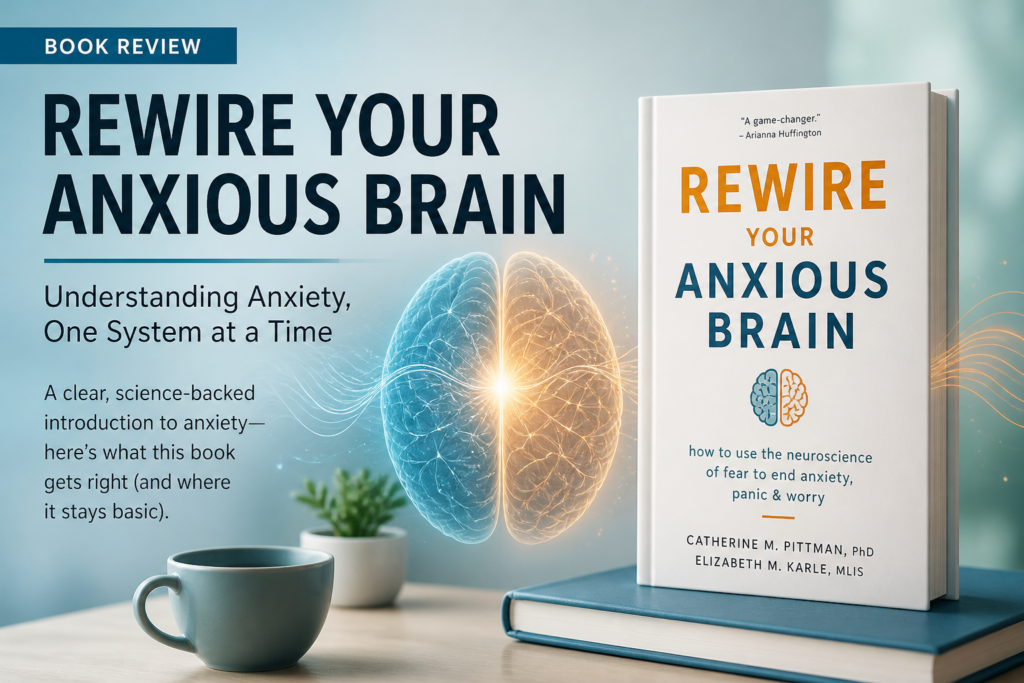
Instead of overwhelming the reader with complex terminology, the authors focus on clarity. They explain how these two systems operate, how they trigger different kinds of anxiety, and why the same approach does not work for every situation. It is a framework that helps you make sense of experiences that often feel random or uncontrollable.
Now imagine the difference this makes in a real situation. A sudden panic response is not something you can simply “think away,” because it originates in a different part of the brain. On the other hand, persistent worry can sometimes be addressed through cognitive techniques. By separating these two, the book gives readers a more structured way to approach anxiety.
Alongside this explanation, the authors offer practical strategies aimed at both systems. Breathing techniques, exposure methods, and cognitive reframing are presented as tools that can be applied depending on the type of anxiety you are dealing with. The emphasis is not just on understanding, but on doing.
However, while the clarity of the book is one of its biggest strengths, it also reveals its limitations.
Much of the advice, especially on the cognitive side, may feel familiar if you have read other self-help or anxiety-focused books. The techniques are effective, but they are not always new. In that sense, the book works more as a structured introduction rather than a deep exploration.
While the authors simplify the science effectively, the model itself—the clear divide between the amygdala and cortex—can at times feel a little too neat for the complexity of real-world anxiety. Human behavior rarely fits into clean categories, and some readers may find that their experiences overlap more than the framework suggests.
That said, the book does not aim to be exhaustive. It aims to be accessible. And in that role, it succeeds.
Rewire Your Anxious Brain works best as a starting point—a way to understand what is happening beneath the surface when anxiety takes hold. It gives language to experiences that are often difficult to describe and offers a set of tools that can help readers begin to respond differently.
If you are new to exploring anxiety or looking for a clear, science-backed explanation without getting lost in technical detail, this self-help book is a solid place to begin. For more experienced readers, however, it may serve more as a refresher than a revelation.
Similar Books You May Like
- The Anxiety and Phobia Workbook — Edmund Bourne
More comprehensive, workbook-style approach - Feeling Good — David D. Burns
Strong focus on cognitive behavioral techniques - The Body Keeps the Score — Bessel van der Kolk
Deeper exploration of trauma and brain-body connection - Dare — Barry McDonagh
More action-oriented approach to anxiety - Unwinding Anxiety — Judson Brewer
Neuroscience-driven but more habit-focused