What if the most dangerous impact of artificial intelligence isn’t some distant superintelligent machine, but a phone call that sounds exactly like your child asking for help?
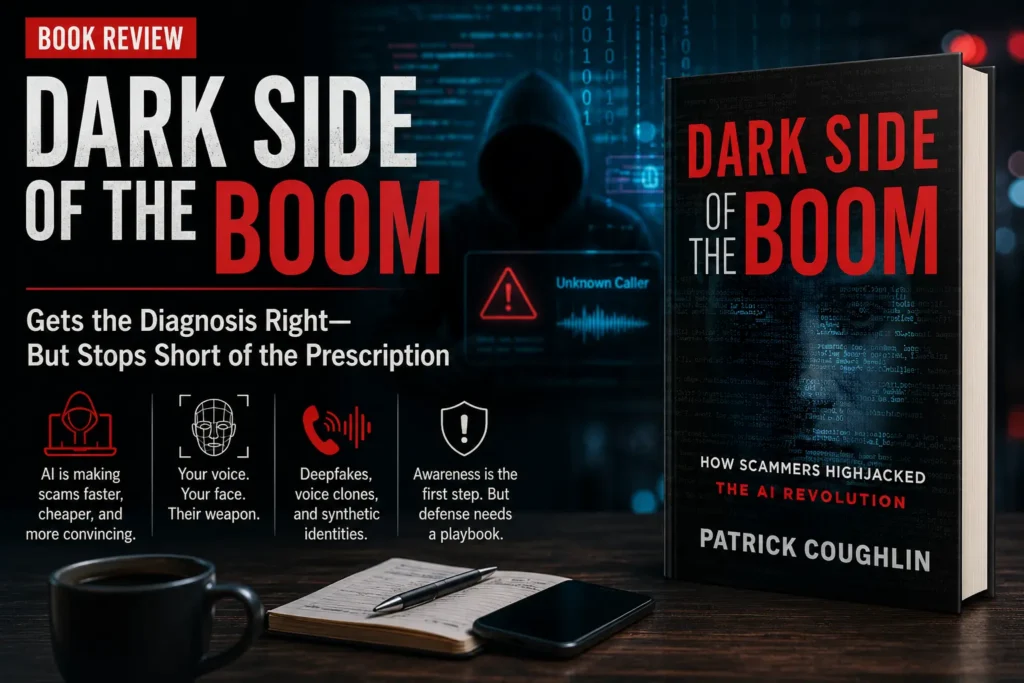
That is the unsettling reality Patrick Coughlin explores in Dark Side of the Boom. While much of the public conversation about AI revolves around future possibilities, Coughlin directs our attention to a threat that is already here: scammers and cybercriminals using AI to make old cons faster, cheaper, and far more convincing.
The result is an engaging and often alarming examination of how fraud is evolving in the age of artificial intelligence. Yet while the book excels at explaining the problem, it leaves readers searching for a more comprehensive playbook for defending themselves.
The Technology Is New. The Con Is Not.
One of the book’s strongest insights is that AI has not fundamentally changed the nature of scams.
The fraudsters are the same. The tactics are largely the same. The victims are often the same.
Whether it is loneliness, fear, greed, trust, or the desire to help a loved one, scammers continue to exploit predictable human emotions. AI simply allows them to do it at a scale and sophistication that was previously impossible.
Throughout the book, Coughlin demonstrates how criminals prey on emotional vulnerabilities. Some target people seeking companionship. Others exploit panic and urgency. Particularly compelling are discussions about seniors, many of whom have spent their lives respecting institutions and authority figures.
When a convincing caller claims to represent law enforcement, a government agency, or a financial institution, fear can override logic. The scam succeeds not because the victim is unintelligent, but because the criminal understands human psychology.
This emphasis on people rather than technology gives the book depth beyond a typical cybersecurity title.
AI Is Putting Fraud on Steroids
If the scams themselves are familiar, the tools behind them are not.
Coughlin walks readers through a growing arsenal of AI-powered deception, including voice cloning, deepfake images, synthetic identities, and highly personalized social engineering attacks.
The book repeatedly drives home an uncomfortable truth: our digital footprints have become raw material for criminals.
Photos shared online, voice recordings, social media posts, leaked personal information, and data stolen through corporate breaches can all be combined with modern AI tools to create believable alternate realities.
The old advice to “trust your eyes and ears” no longer carries the same weight.
A voice may not be real.
A photograph may not be real.
Even a video may not be real.
That erosion of trust may be one of the most significant societal consequences of AI, and Dark Side of the Boom effectively captures the scale of the challenge.
Where the Book Falls Short
For all its strengths, the book has a notable weakness.
It is excellent at diagnosing the disease but less effective at prescribing treatment.
Readers are presented with numerous examples of how scams work and why they succeed. The case studies are informative and often memorable. However, the practical guidance is scattered throughout the narrative rather than organized into a clear defensive framework.
A dedicated chapter focused on scam prevention would have elevated the book considerably.
Simple principles could have reinforced the lessons:
- Pause before sending money.
- Verify requests through independent channels.
- Treat urgency as a warning sign.
- Be skeptical of demands involving cryptocurrency, gift cards, or wire transfers.
- Confirm identities even when a voice sounds familiar.
Many of these ideas appear indirectly within the stories, but they never fully come together into a reader-friendly toolkit.
As a result, the book sometimes feels more like a comprehensive reference guide to modern scams than a practical handbook for avoiding them.
An Important Contribution to the AI Conversation
Despite that criticism, Dark Side of the Boom succeeds in an important way.
It shifts the AI discussion away from speculative future scenarios and toward immediate, real-world consequences.
While headlines often focus on whether AI will transform civilization decades from now, Coughlin reminds readers that criminals are already using these technologies today. The threat is not hypothetical. It is operational.
That perspective alone makes the book worthwhile.
Too often, discussions about artificial intelligence become abstract. Dark Side of the Boom grounds the conversation in everyday risks facing families, seniors, businesses, and anyone with a digital presence.
Final Verdict
Dark Side of the Boom is a timely and accessible examination of how artificial intelligence is transforming fraud and deception. Patrick Coughlin effectively demonstrates that the greatest danger may not be AI itself, but the way criminals are using it to exploit timeless human vulnerabilities.
The book’s biggest limitation is its lack of a dedicated, actionable defense strategy. Readers will learn how scams operate, but many may wish they received more structured guidance on how to resist them.
Still, as an introduction to the rapidly growing world of AI-powered fraud, it is both informative and relevant.
Recommended for: readers interested in cybersecurity, AI, digital privacy, consumer protection, and anyone concerned about how emerging technologies are changing everyday risks.
Not ideal for: readers looking for a practical step-by-step anti-scam manual.
In the end, Dark Side of the Boom serves as an effective warning. It teaches readers how the scammers think. It just stops a little short of teaching them exactly how to fight back.
SIMILAR BOOKS
Scam Me If You Can — Frank Abagnale
Explores modern fraud tactics and how consumers can protect themselves from increasingly sophisticated scams.
The Art of Deception — Kevin Mitnick
A classic examination of social engineering and the human side of cybersecurity.
Futureproof — Kevin Roose
Looks at how emerging technologies, including AI, are reshaping everyday life.
This Is How They Tell Me the World Ends — Nicole Perlroth
Investigates cyber threats and the hidden world of digital vulnerabilities.
The Coming Wave — Mustafa Suleyman
Examines the opportunities and risks posed by powerful technologies, including artificial intelligence.