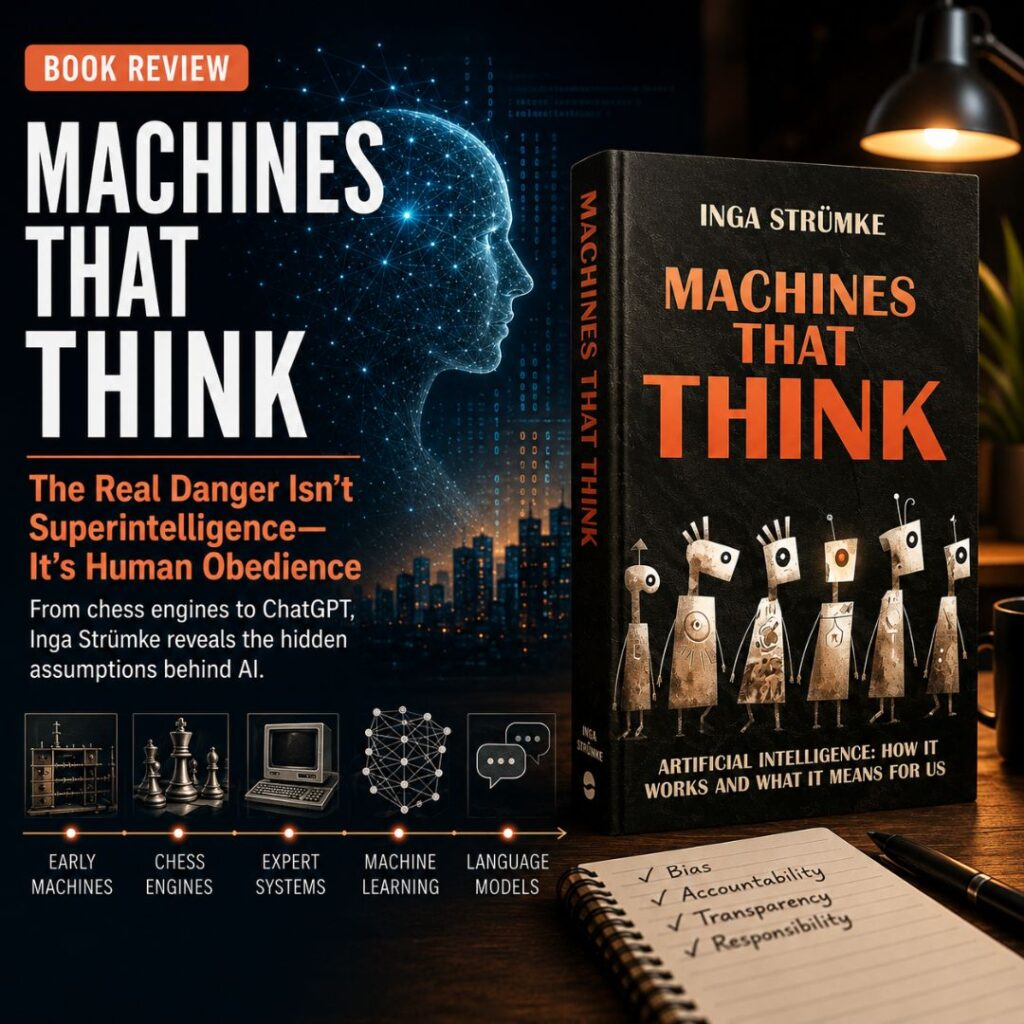
What happens when machines become smart enough to guide our decisions — but humans become too comfortable to question them? Inga Strümke’s award-winning AI explainer moves beyond hype and asks a far more uncomfortable question: why are humans so ready to trust systems they barely understand?
That anxiety sits underneath nearly every page of Machines That Think, even when the book appears to simply be explaining algorithms, neural networks, or the history of computing. Physicist and AI researcher Inga Strümke begins with an ethical question about responsibility: if an intelligent machine fails, who carries the blame? The engineer? The company? The user? Or the machine itself?
It is a deceptively simple question. And by the end of the book, Strümke makes it clear that the real problem may not be whether machines can think like humans, but whether humans slowly stop thinking for themselves.
That is what makes Machines That Think more interesting than many recent books about artificial intelligence. While countless AI titles either drift toward techno-utopian hype or collapse into apocalyptic fearmongering, Strümke takes a calmer and far more useful route. She treats AI neither as magic nor as doom. Instead, she explains it as a system built by humans, trained by humans, and limited by human assumptions.
From Chess Machines to ChatGPT
The book moves quickly through the history of computing and early AI systems. Readers are guided from primitive rule-based machines and symbolic AI toward machine learning, neural networks, and modern large language models.
At first, the writing feels intentionally broad and highly accessible. Readers without a technical background will likely appreciate how clearly Strümke explains foundational concepts. She avoids unnecessary jargon and keeps the tone conversational.
For technically experienced readers, however, the early chapters may feel overly familiar. The introduction to computing history and basic AI concepts occasionally risks sounding too simplified. But then the book changes its tone as it delves into expert systems and moves toward complex topics.
She explains that when humans solve problems, we unconsciously rely on enormous amounts of hidden contextual knowledge. We understand social cues, probabilities, physical limitations, emotional nuance, and common sense without explicitly listing every assumption. Machines cannot do that.
Early AI systems had to be manually told every rule, every possibility, every exception. Even now, modern AI systems still struggle with the same issue in more sophisticated ways. They can recognize patterns at astonishing scale, but they do not possess human understanding in the way people casually assume. Much of today’s AI discourse quietly encourages people to mistake prediction for intelligence.
The Hidden Human Layer Inside AI
One of the book’s strongest achievements is showing that artificial intelligence is never truly independent from the people who build it.
Strümke repeatedly returns to a principle that can be summarized simply: Garbage in, garbage out. Only now there is a learning layer sitting between the input and output.
Machine learning systems can filter, adjust, optimize, and improve predictions over time. But they still depend on human choices:
- what data is collected,
- which patterns matter,
- how success is defined,
- what gets ignored,
- and who acts as the gatekeeper.
The book becomes especially compelling when discussing failures in high-stakes environments. One example involving hospital systems demonstrates how incomplete or undocumented medical reasoning led AI systems toward dangerous conclusions. The machine identified correlations, but it lacked the deeper context doctors unconsciously apply when treating patients.
That example captures the book’s larger warning. AI systems often fail not because they are evil or conscious, but because humans mistake statistical association for understanding.
Now imagine extending that logic into policing, finance, warfare, hiring, education, or public governance. The consequences become much larger.
The Quiet Trade-Off Behind Modern AI
One of the most fascinating ideas running through Machines That Think is how AI evolved from explainable systems toward increasingly opaque ones.
Symbolic AI required explicit instructions. Engineers could often trace exactly why the system reached a conclusion. Modern machine learning systems are different. They are vastly more powerful. But they are also harder to interpret.
In exchange for convenience and capability, society has gradually accepted systems we often cannot fully explain. That trade-off sits underneath everything from recommendation algorithms to generative AI tools.
And Strümke understands something many popular AI commentators miss: people are becoming comfortable with that opacity remarkably quickly. The real danger then in AI may not be superintelligence. It may be human obedience.
The willingness to accept machine outputs without scrutiny. The willingness to assume the algorithm must know better. That idea gives the book philosophical weight far beyond a standard “AI explained” title.
Accessible — Until It Gets Dense
One of the more honest things that should be said about the book is that its accessibility changes over time. The opening chapters are highly readable for general audiences. But as the book progresses deeper into machine learning, training models, and neural networks, the concepts become noticeably denser.
This is not necessarily a flaw. In fact, it may be one of the book’s strengths. Strümke refuses to oversimplify difficult ideas merely to preserve readability. She expects readers to stay intellectually engaged.
Still, some non-technical readers may find the later sections demanding, especially if they have little interest in science or computational thinking. At the same time, readers who persist through the more complex material are rewarded with a far clearer understanding of what machine learning actually means beyond corporate buzzwords.
The chapters explaining training processes are particularly useful for readers trying to understand how modern generative AI systems behave — and misbehave.
A Book More Interested in Human Weakness Than Machine Power
The final sections turn toward the question almost every AI book eventually reaches: How intelligent can machines become?
Strümke approaches the topic carefully. She acknowledges that machines already outperform humans in certain forms of computation and pattern recognition. Yet she also points out that humanity still barely understands consciousness or even the full functioning of the human brain.
That uncertainty makes predictions about superintelligence deeply unreliable. Importantly, the book avoids pretending to know the future. Instead, Strümke redirects attention toward a more immediate concern: human behavior.
The most unsettling idea in Machines That Think is not that AI might become uncontrollable. It is that people may willingly surrender judgment, responsibility, and skepticism long before that ever happens.
And looking at how rapidly society now accepts algorithmic recommendations, autogenerated information, and machine-assisted decisions, the warning feels less theoretical than it once did.
Final Verdict
Machines That Think succeeds because it treats readers like adults. It neither sensationalizes artificial intelligence nor reduces it to simplistic optimism. Instead, Inga Strümke offers something increasingly rare in technology publishing: nuance.
The book works best for curious readers who genuinely want to understand how AI systems function beneath the headlines. It is particularly strong for readers interested in ethics, machine learning literacy, and the hidden assumptions built into modern technology.
Technical readers may find parts of the opening overly basic, while some casual readers may struggle once the concepts become more advanced. But that tension also reflects the subject itself. Truly understanding AI requires moving beyond marketing language into complexity. And Strümke is willing to take readers there.
For anyone trying to understand not only what artificial intelligence can do, but also why humans are increasingly willing to trust it without question, Machines That Think is one of the more thoughtful introductions currently available.
SIMILAR BOOKS
1. The Alignment Problem — Brian Christian
A deeper exploration of bias, ethics, and machine learning systems.
2. AI Superpowers — Kai-Fu Lee
Useful for readers interested in the global and economic implications of AI.
3. Human Compatible — Stuart Russell
Explores how humans can maintain control over increasingly powerful AI systems.
4. Life 3.0 — Max Tegmark
A broader philosophical look at the future relationship between humanity and artificial intelligence.
5. Atlas of AI — Kate Crawford
Examines the hidden labor, politics, and infrastructure behind modern AI systems.